
.jpg)

Earlier this month, Jared Jameson (Chief Investment Officer) and Brandon Arns (Portfolio Manager) hosted WJ Interests' investment webinar, Let the Good Times Roll, where we discussed an extraordinary stretch of market performance and how we are positioning portfolios for what lies ahead in 2026. Whether you joined us live or were unable to attend, this WJNotes recaps many of the core themes from the presentation and expands on what they may mean for investors.
It's Been “Good Times” for Global Stock Portfolios
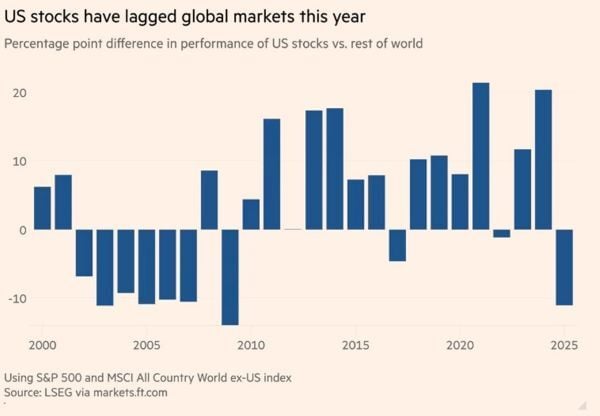
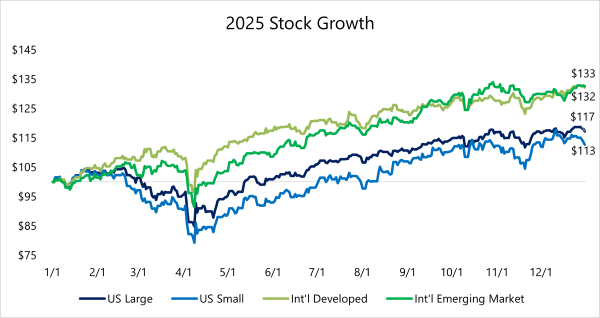
The last three years (2023–2025) have been a fabulous period for stock investors, with global stocks advancing around ~65% during that period. While U.S. stocks have dominated headlines for over a decade, 2025 marked a significant shift where international markets took the lead:
-
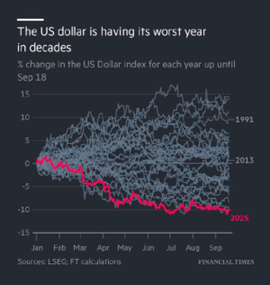
International Developed and Emerging Market Stocks were the top performers in 2025, delivering a 33% and 32% return. Much of that outperformance came as the U.S. dollar experienced one of its weakest years in decades.
-
U.S. Large-Cap Stocks, while still strong, trailed at 17%, the first time in several years they have lagged international markets. U.S. Small-Cap Stocks followed with a 13% return.
This divergence highlights the importance of global diversification as well as valuation. While the most profitable companies of 2025 continued to reside in the US, they are priced at a much higher valuation than stocks outside the US. When that’s the case, just a small shift in sentiment can lead to major outperformance as it did last year.
 The Shift from Cash to Bonds
For several years, we have been advocating for investors to move away from high cash allocations. For the past two years, "sitting in cash" seemed like a viable strategy with yields around 5%, however your opportunity cost in virtually every other investment has been immense. We continue to advocate a shift away from cash, especially as the yield dips below longer maturity bonds. Below are a few of the reasons why:
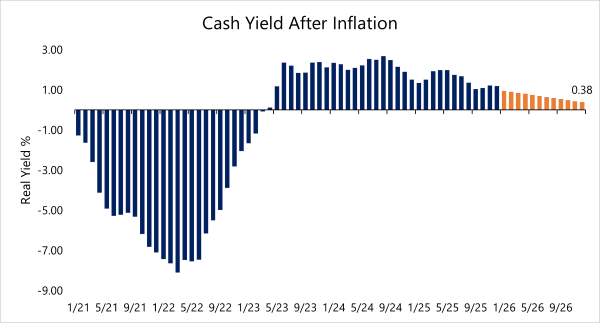
Falling Cash Yields: As the Federal Reserve continues to cut interest rates, cash yields after inflation (real yields) are projected to drop significantly, likely falling to between 0.3% and 0.4% by year end.
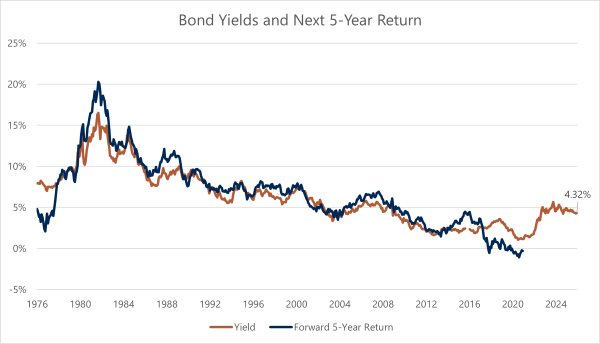
 Higher Bond Yields: The general bond index has a starting yield around 4.32% (vs 3.65% for cash). However, WJ’s managed bond portfolios yield much more, between 5% and 6%.
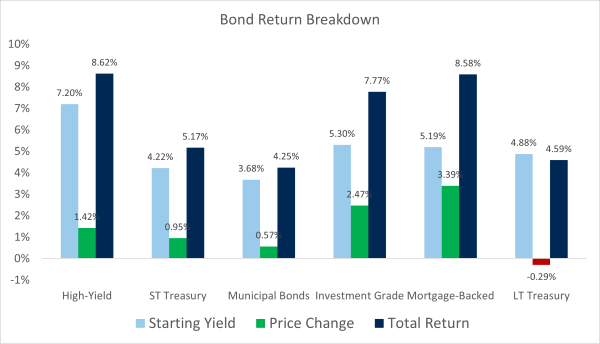
In 2025, Bonds (using the Bloomberg US Aggregate Bond Index) provided a solid 7%, their best year since 2019. The chart below highlights how bonds benefited from their high starting yields, as well as price appreciation due to rates falling during 2025.
Forward Outlook: Historical data shows a strong correlation between starting bond yields and the next five years of returns, making current levels very attractive for long-term income.
 The Benefit of Alternatives
Reinsurance continues to be a standout "alternative" asset class that provides equity-like returns with low correlation to the broader stock market. Recall that reinsurance acts as "insurance for insurance companies," and its recent success illustrates its value to client portfolios.
-
2023: 44% return
-
2024: 31% return
-
2025: 30% return
-
In the last 5 years, reinsurance has achieved a 20% annualized return.
Other diversifying alternatives such as managed futures struggled last year, however they’ve greatly reduced the volatility of our portfolios, and have consistently been our best investment when stocks and bonds fall.
The Power of Small Wins: Diversification and "Return Stacking"
Many investors think about portfolios in terms of individual investments. We tend to think about them in terms of how different investments fit together to improve the overall efficiency of the portfolio (efficiency meaning most return per unit of risk). One of the most significant contributors to our success over the last several years has been the implementation of strategic leverage, commonly referred to as "Return Stacking."
What is Return Stacking?
In a traditional portfolio, if you want to add an "alternative" investment like Reinsurance or Managed Futures, you typically have to sell some of your stocks and/or bonds to pay for it. With Return Stacking, we use a small amount of strategic leverage to "stack" these diversifiers on top of a core foundation of stocks and bonds. This allows us to maintain full exposure to the booming stock market while also retaining the diversification properties of alternatives.
This strategy, commonly referred to as “Portable Alpha” has existed for decades, but the tools to execute it were not available to us until 2020, when FINRA gave the ok for ETFs to use derivatives to achieve leveraged exposures. WJ, having already understood the benefits of this approach, immediately got to work to implement it.
Consistency over 6 Straight Years
The result of this sophisticated structuring has been remarkably consistent as we’ve been able to add value beyond our benchmarks for six consecutive years. While the value we’ve added might seem modest in any single year (0.5% - 2% most years) the section below highlights why this is so impactful. We don't need "home runs" every year; we need a consistent, repeatable edge.
The 30-Year Mathematical Edge
To illustrate the power of adding small but consistent bits of excess performance, we shared a chart showing the growth of $1 million over 30 years at a base return of 6.5%, and how it changes with incremental outperformance.
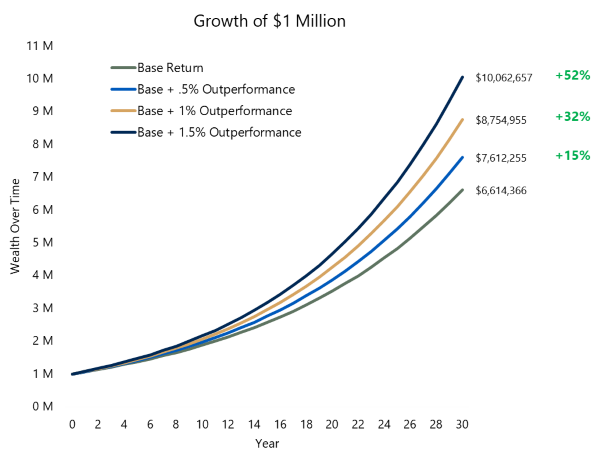 An extra 1% of annual outperformance translates to $2.1 million (or 32%) more wealth over a 30-year period. This demonstrates that the "good times" don't just come from market rallies, they come from the compounding effect of a disciplined, diversified, and strategically leveraged investment process.
Looking Ahead: AI, Energy, and Global Policy
Our outlook for 2026 is shaped by several major "big picture" themes that will impact both markets and everyday costs:
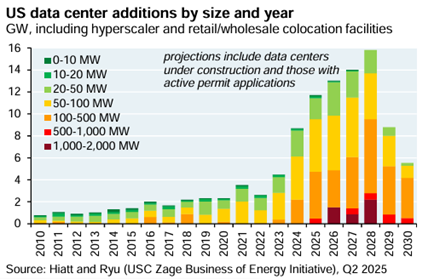
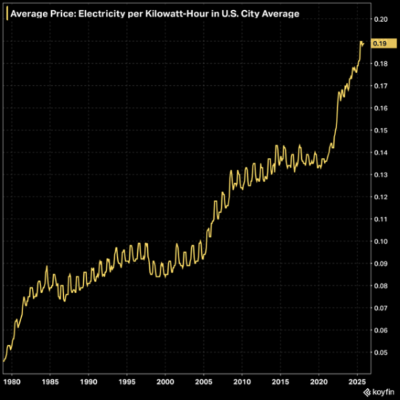
The AI Power Crunch: The expansion of AI and data centers is creating massive demand for electricity. In 2025, AI power demand reached 12 GW, equivalent to the energy needed for 12 million homes. This surge is a major driver behind rising electricity prices, which have climbed from a national average of $0.13 to $0.19 per kWh.
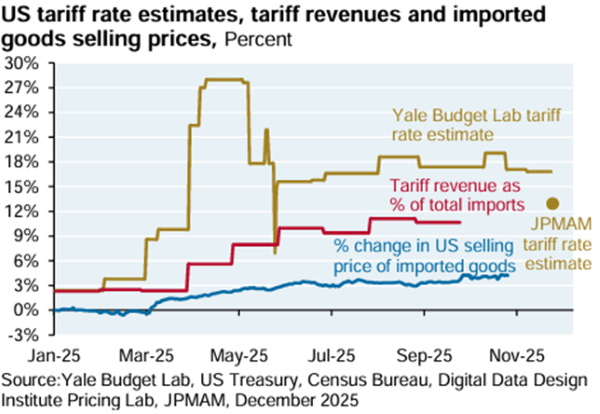
Tariffs and Inflation Analysis: While early on President Trump proposed 30% tariff rates, he quickly adapted to the market reaction and reduced the effective rate to around 10–11%. During most of 2025, American businesses were willing to absorb most of that cost, so the direct impact on consumer prices was only estimated to be around 5%.
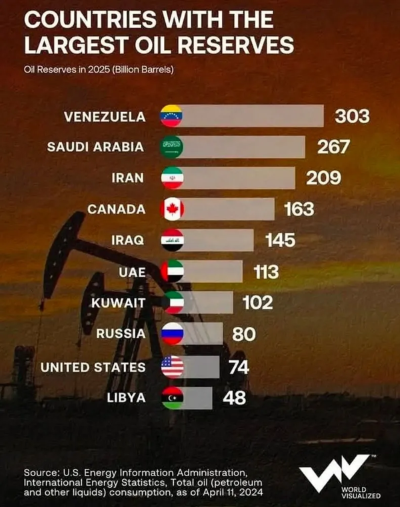
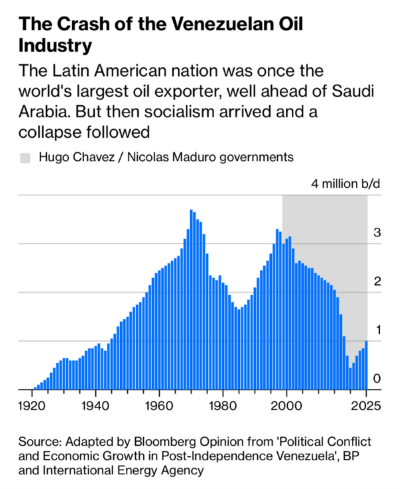
Venezuela and Global Energy: We also addressed the capture and arrest of Venezuelan President Nicolas Maduro. The administration has been pretty explicit in its goal to monetize the country’s vast oil reserves, estimated to be around $300 billion barrels, the most in the world. Due to poor management, however, the country is only producing about 1 million barrels per day, down from 4 million 25 years ago. President Trump would like to see US oil companies invest to restore that production, but many estimates say this would require a massive $100 billion investment over 15 years, meaning a sudden global energy surplus from this region is unlikely in the near term.
 Strategic Takeaways
The overarching message of "Let the Good Times Roll" is one of disciplined optimism. While U.S. stocks remain expensive relative to history, opportunities in international markets, bonds, and alternatives like reinsurance remain robust. Our focus remains on broad diversification and avoiding the "painful" pitfalls of trying to time the market.
Want to learn more? You can view the webinar recording above or contact your WJ advisor to discuss how these themes apply to your specific portfolio.
PAST PERFORMANCE IS NOT A GUARANTEE OF CURRENT OR FUTURE RESULTS. Examples of historical information included in this presentation do not, nor are they intended to, constitute a promise of similar future results. Specific client portfolio allocations, risks and returns can and may deviate from these examples depending on accounts and types of investments available through each account. Future market views by WJ Interests, LLC may vary significantly from the historical examples presented herein and no one receiving this summary should assume that WJ Interests, LLC will be able to replicate successful views in the future.
Blended Portfolio is for illustrative purposes only. It is calculated by taking a weighted average of the following asset classes and represents a moderate risk portfolio:
| 27% US Large Stock | iShares Russell 1000 (IWB) |
| 6% US Small Stock | iShares Russell 2000 (IWM) |
| 21% Intl Developed Stock | iShares Core MSCI EAFE (IEFA) |
| 6% Intl Emerging Stock | iShares Core MSCI Emerging Markets (IEMG) |
| 40% Bonds | Vanguard Total Bond Market (BND) |
| Cash | Morningstar USD 1M Cash TR USD |
| Reinsurance |
Stone Ridge Reinsurance Fund (SRRIX) |
| Managed Futures |
SG Trend Index, PIMCO Trends (PQTIX), Virtus Alphasimplex (ASFYX), Standpoint (BLNDX) |
| TAA | GMO Benchmark Free (GBMIX) and Strategy Shares Nwfnd/Rslv Rbt ETF (ROMO) |
Assumes annual rebalancing. All data represents total return for stated period.