


Forecast season is back. Last year, I laid out a set of expectations for how the economy and markets might evolve in 2025. In this post, I’ll briefly revisit those calls and then turn to what I think 2026 may hold. As with last year, each view will be tagged as Mainstream, Balanced, or Bold to separate consensus thinking from more differentiated opinions.
While forecasts are inherently uncertain and the future rarely unfolds exactly as expected, the exercise itself is still valuable. Writing down concrete views forces you to organize scattered thoughts into a coherent framework. It turns a collection of “I thinks” into an explicit set of assumptions about growth, inflation, markets, and risk. Revisiting those views a year later is often more instructive than the forecasts themselves. It highlights where judgment was sound, where blind spots existed, and which narratives carried more weight than they deserved.
With that being said, a couple important caveats we have to get out of the way:
- This is my personal opinion, and not reflective of anyone else at WJ, or WJ itself.
- We don’t make investment decisions off of short-term predictions, and you shouldn’t either.
Recap of 2025 Projections
Below is a summary of my predictions and the result, however, you can read my original rationale for each here.
| Prediction | Results and Explanation |
| Inflation Lower Than Start of Year | CPI came down from 2.9% at the start of the year to 2.7% by year end. This was probably my least consensus prediction from last year, so I’m most pleased with it. It was universally agreed that the potential tariff policies coming would raise inflation and slow growth, and I agreed with that analysis. However, my counter was that President Trump would be unable to push or maintain the full version of his tariffs, and that’s been exactly the case. In addition, I believed structural factors in shelter and oil/gas inflation would hold CPI down, offsetting any increase in goods from tariffs. This happened exactly as predicted as well. |
| Similar GDP Growth, No Recession | We’re still waiting for Q4 data, but given Q3 GDP growth of 4.3%, it’s safe to say this will be very close. There was a scare with negative Q1 GDP, but this was quickly offset by higher subsequent quarters. |
| Interest Rates Down | This call was contingent on my inflation/growth predictions being right, and that worked out. The 10-year treasury rate came down from about 4.6% to 4.15% today. In addition, the Fed cut short term rates 3 times (.75%), following what I wrote would happen last year. |
| Mortgage Rates Down and Home Prices Up Moderately | The 30-year mortgage rate came down from 7.05% to 6.21% over the year. Using S&P Case-Shiller U.S. National Home Price Index, home prices are up about 1.5% up to November. All of that growth came in the first half of the year, and prices have actually fallen the last 5 months. So, correct on both fronts, though if I’m being honest, I would’ve thought prices were up more with the drop in rates. |
| Bonds Do Better Than Their Yield | This was also out of consensus, as most economists were sure inflation was going to reignite. However, despite starting the year with a yield of about 5%, the bond market returned over 7% as yields fell. |
| Below Average Year for Stocks, with New Winners |
Last year I predicted we’d get new leadership in stocks, and that was very right when it comes to international stocks, which outperformed US stocks by 15-20%. In addition, the Mag 7 stocks which have been carrying the market for several years mostly underwhelmed, aside from Google and Nvidia which continue to dominate. Despite underperforming international stocks, the S&P 500 still finished up about 17%, marking a very solid year, though below an average UP year (~21%). It was still better than I expected. I’ll take half credit for this one. |
| Bitcoin Crashes |
BTC started 2025 at about 100k (110k a week earlier) and ended around 87k (-13%). However, from peak to trough, BTC crashed about 33% from October to November. This is despite a year in which stocks grew ~20% globally. A lot of positive developments happened to bitcoin this year, as predicted, however, that optimism turned out to be mostly priced in. |
I’d say that’s 6 right, and 1 pretty close. Pretty happy with that, so on to 2026.
2026 Predictions
- Difficult year for stocks, particularly US stocks (Bold): This is the boldest prediction, so I’m putting it first. It'll also have the longest explanation since it's the most contrarian. I think stocks will have a full correction this year, defined as a drop of about 20% (occurring about 17% years since 1951). Where the market ends up at the end of the year depends on the timing of course, but I'll assume it happens late enough to where we end the year down. There are 2 reasons why I think this is the year to be bearish (despite most years being positive): Complacency and Base Rates.
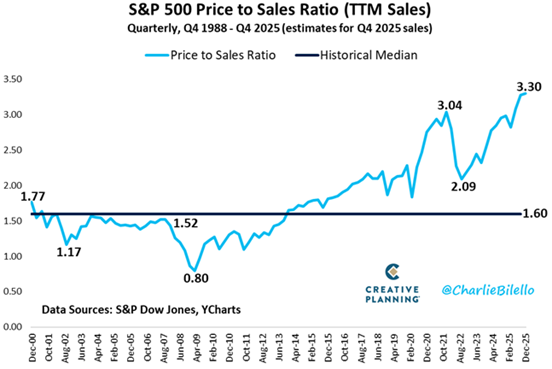
Complacency: There is little fear in the market right now in my opinion. The economy is solid, and it's not obvious what’s going to throw it off. Regulations and taxes are lighter, AI spending is full speed ahead, and the Fed is lowering interest rates. These all point to continued strength...and that’s the point. When everyone sees clear skies ahead, markets go up to reflect the relative lack of risks, and any new or unforeseen risks can quickly cause panic. One way to read complacency is by looking at stock valuations. Price to sales ratio is a popular valuation metric, and at 3.3 the S&P 500 is at its highest in history.
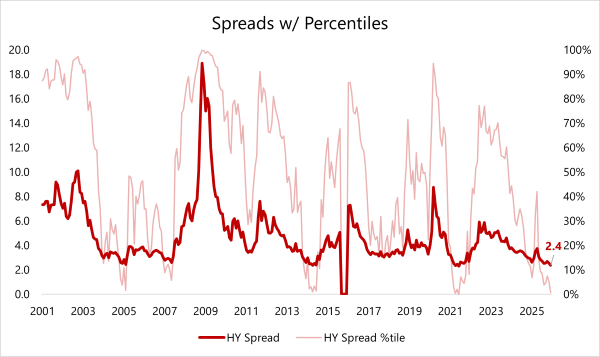
 One of the clearest signals of market complacency comes from high-yield credit spreads. The additional yield investors require to bear credit risk is sitting near historic lows, implying risks are being heavily discounted.
 The next chart shows “Market Strategists” S&P 500 forecasts. The estimates range between 1% to 14% returns each year, as you can see below.
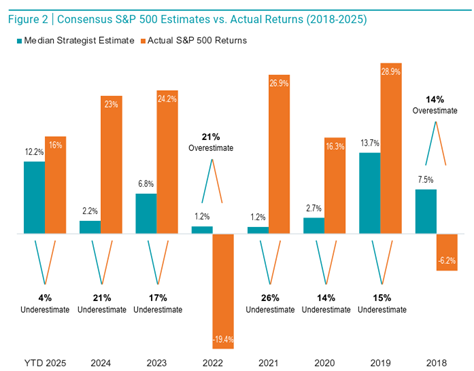 They underestimated returns over the past three years, and to make up for it, they are now forecasting nearly 10% annual returns, with not a single strategist calling for a down year. The individual forecasts are below…
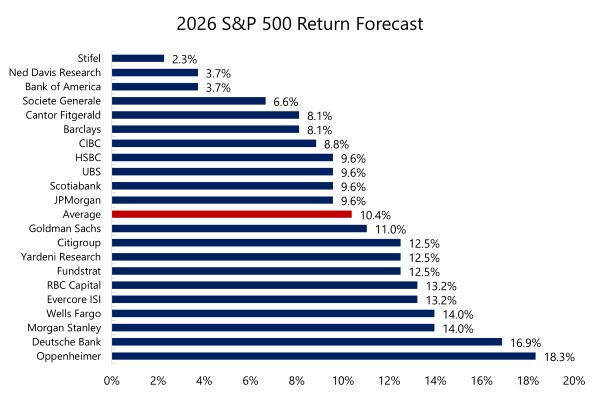
I think this is too optimistic and they will overestimate this year. Next reason is base rates.
Base Rates: In addition to my general feelings on the market, it's important to understand what’s likely to happen if you knew nothing at all. This is called a base rate, the probability of an outcome before considering any specific story, forecast or narrative.
If you separate S&P 500 returns into up years and down years, the average up year is about 21%, while the average down year is roughly negative 13%, as the chart shows.
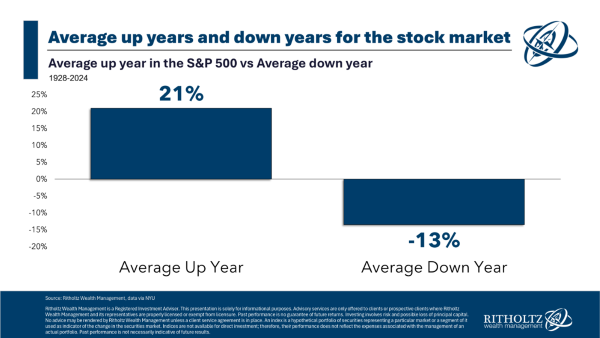
To end up at the historical average (~12%), that means that roughly 1 in 4 years is down. Coincidentally, the last 3 years have averaged just over 21%. In a random game of chance, this is irrelevant, you’d still have a 75% chance of a good year next year. Periods of optimism often help create the conditions for future disappointment in markets. Fortunately, WJ has prepared for this by “raising the levee”.
- Inflation higher than today (Bold): The exact opposite of what I expected last year. The biggest change in my thinking is that the drag from housing inflation coming down now appears to have largely run its course. At the same time, Trump has had a year where tariffs have not visibly “broken” anything, which likely makes him more willing to expand them. So far, the impact of tariffs has been muted because many corporations have absorbed the costs, shielding consumers (and CPI) from higher prices. That is unlikely to last. Over time, those costs are more likely to be passed through, keeping upward pressure on goods prices.
- Similar GDP Growth, No recession (Mainstream): Same as last year. We’re going to get a year of stimulus from the OBBBA, and a lot of AI spending that has already been promised is likely to come this year. Those two things should keep the GDP healthy. That being said, there is employment, wage and spending weakness on the lower income cohorts in the economy. I think it’ll take more than this year for that to evolve into a recession, but it’s a real risk worth watching this year.
- Short Term Interest Rates Down, Long Term Up (Bold): This dynamic, where long-term rates rise while short-term rates fall, is known as a “steepener” (since the curve between short and long maturities becomes steeper on a chart). I see the first half of this forecast as highly likely. Trump is expected to announce his nomination for Fed Chair soon, with that person leaning towards lower rates. While the Chair does not control policy unilaterally, the role carries meaningful influence over the committee that sets rates. I believe this shift could put upward pressure on longer-term yields, particularly if inflation pressures build. If inflation remains sticky or begins to rise while the Fed moves to lower short-term rates, that combination could add fuel to inflation expectations and push long-term rates higher.
- Changes Coming to the Housing Market (Balanced): It’s hard to quantify this or point to something specific, but I think there will be a major piece of legislation changing the housing market in 2026. FHFA director, Bill Pulte, has already mentioned some aggressive ideas, such as a 50-year mortgage, or assumable and portable mortgages. These were met with much skepticism; however, housing is one of the most important issues Americans face, and with midterm elections coming up, I think it’ll be something the administration tries to address. While I don’t know the exact policy, it will certainly be looser, making it easier to purchase a home.
- Bonds Underperform (Balanced): Sticky inflation will keep rates from dropping too much, arguing for bonds to about earn their yield. However, the other factor for bond performance is credit spreads, or how much extra you’re paid to lend to businesses over the government. That spread is extremely thin at the moment, so I’d look for that to widen a bit, leading to muted bond performance this year.
- Private Market Turmoil (Balanced): Private markets are popular in part because they appear to offer high returns without the day-to-day volatility. That can create an illusion of stability during periods of stress. After several high-profile breakdowns late in 2025, I believe more will surface in 2026. Not catastrophic, but meaningful.
- Crypto has a difficult year (Balanced): Up until about four months ago, there was arguably no better place to be than crypto. The new administration was openly supportive, a more accommodating SEC Chair was appointed, and crypto ETFs went mainstream, gathering assets at a pace rarely seen. Public companies even began repositioning themselves as “digital asset treasuries,” borrowing capital to accumulate crypto because investors, somewhat remarkably, were willing to assign those equities higher values than the underlying digital assets themselves. It was a strange strategy that most rational observers recognized as unsustainable, but for a time it worked. It helped push parts of the crypto market, particularly bitcoin, to new highs.
However, as 2026 unfolds, it will bring no shortage of headlines, surprises, and opportunities. We’ll continue to monitor these themes closely and adjust as conditions evolve. Wishing everyone a healthy, prosperous, and interesting 2026!
If this WJ Insights sparked any debate or new perspectives, I’d encourage you to share it with friends or colleagues and compare notes.
PAST PERFORMANCE IS NOT A GUARANTEE OF CURRENT OR FUTURE RESULTS. Examples of historical information included in this presentation do not, nor are they intended to, constitute a promise of similar future results. Specific client portfolio allocations, risks and returns can and may deviate from these examples depending on accounts and types of investments available through each account. Future market views by WJ Interests, LLC may vary significantly from the historical examples presented herein and no one receiving this summary should assume that WJ Interests, LLC will be able to replicate successful views in the future.