


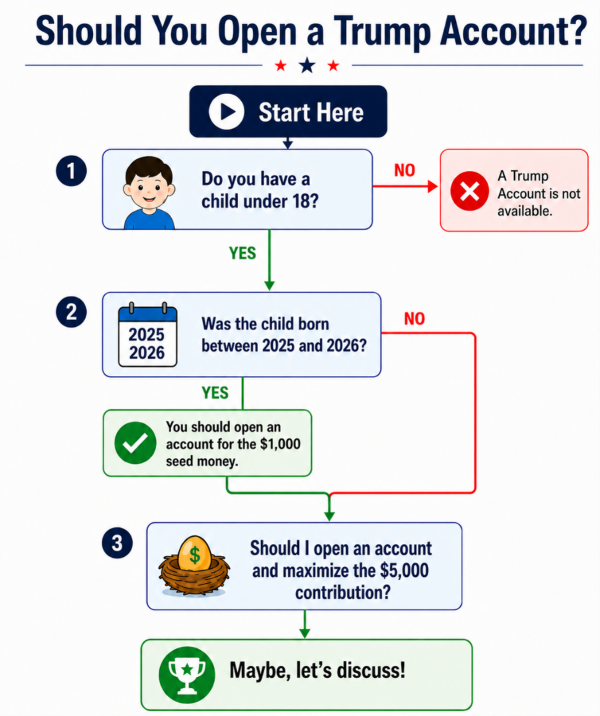
July 4 has come and gone, and the highly anticipated Trump Accounts have officially launched. These new accounts are available for children under age 18, with a specific one-time $1,000 seed deposit provided by the U.S. Treasury for children born between 2025 and 2028. Now that the accounts are officially available, here are some key points to consider when deciding whether to open one.
 How to Open and Fund an Account
These accounts can now be opened using the Trump Accounts app, available through both the Google Play Store and Apple App Store. The app will direct you to complete Form 4547, and the account will be opened through the app itself. As of now, these accounts can only be held through the app, but there are future plans to allow the accounts to be transferred to custodians such as Charles Schwab.
For 2026 and 2027, each account may receive up to $5,000 in total contributions. These contributions can be made by family members, other individuals, or even employers, if the combined total does not exceed $5,000. The contribution limit will then increase based on inflation. The $1,000 seed deposit provided by the Treasury for children born between 2025 and 2028 does not count toward the $5,000 limit.
Contributions are treated as non-deductible, but earnings will grow tax-deferred until distributions begin after the account becomes the child’s IRA. This means that if contributions continue to be made, the account’s basis will need to be tracked to ensure those dollars are not taxed twice when withdrawn.
These accounts do not require earned income to be funded, making them a unique alternative to other custodial IRAs. To fund a custodial Roth or traditional IRA, the child must have earned income. However, that does not mean families must choose one account over the other. Trump Accounts and custodial IRAs have separate contribution limits, so families could potentially fund both to the maximum amount if all IRS requirements are followed.
Withdrawals and Gift Taxes
Once contributions are made to these accounts, no withdrawals are allowed until the account is converted into the child’s own IRA. This restriction may deter individuals from opening an account if they anticipate a greater need for the funds to be used for goals such as a college education.
Another potential drawback is that anyone who funds one of these accounts may, based on current guidance, need to file a gift tax return with their 2026 tax return. Because the accounts do not allow distributions before the child turns 18, each contribution may technically be considered a “future interest” gift. The annual gift tax exclusion, which is $19,000 per beneficiary in 2026, generally applies only to present-interest gifts.
Because these accounts are so new, it is difficult to know whether this is how the IRS will ultimately treat these contributions as additional guidance is released.
Should You Open an Account for Your Child?
Everyone’s situation is different, and we encourage you to contact someone on our team to determine whether opening one of these accounts would make sense for you and your family. This is a new type of account that creates an opportunity to jump-start your child’s retirement savings without requiring the child to have earned income.
Any free money from the government, such as the $1,000 seed deposit for children born between 2025 and 2028, makes opening an account seem like a straightforward decision. There may also be future large-scale donations, such as the pledge made by Michael and Susan Dell, that could benefit you and your family. However, it appears that these accounts are here to stay, so you do not have to decide immediately. You can always wait for additional guidance and determine whether opening an account makes more sense in the future.
As additional guidance becomes available, the rules and practical uses of Trump Accounts will likely become clearer. For now, families should consider how these accounts fit alongside other savings options, including 529 plans, custodial accounts, and Roth IRAs for children with earned income. The right approach will depend on your family’s goals, timeline, and need for flexibility. Our team will continue to monitor future guidance and help clients evaluate whether these accounts should be included in their broader financial plan.
Key Takeaways
-
$1,000 government seed deposit for eligible children born 2025–2028.
-
No earned income required to contribute up to $5,000 annually.
-
Tax-deferred growth, but funds aren't accessible until the account becomes the child's IRA.
-
Consider Trump Accounts alongside 529 plans, Roth IRAs, and other savings options.
PAST PERFORMANCE IS NOT A GUARANTEE OF CURRENT OR FUTURE RESULTS. Examples of historical information included in this presentation do not, nor are they intended to, constitute a promise of similar future results. Specific client portfolio allocations, risks and returns can and may deviate from these examples depending on accounts and types of investments available through each account. Future market views by WJ Interests, LLC may vary significantly from the historical examples presented herein and no one receiving this summary should assume that WJ Interests, LLC will be able to replicate successful views in the future.