

The news flow has been heavy this year. War in Iran and a reminder of how much that region matters for oil, gas, fertilizer, and…helium (sneaky big one). Exponential progress in AI and infrastructure spending on a scale we associate with railroads, the interstate system, or the internet. Midterms with normally safe seats up for grabs.
Quietly, another story has been unfolding that matters as much as any of these. Interest rates are going up fast.
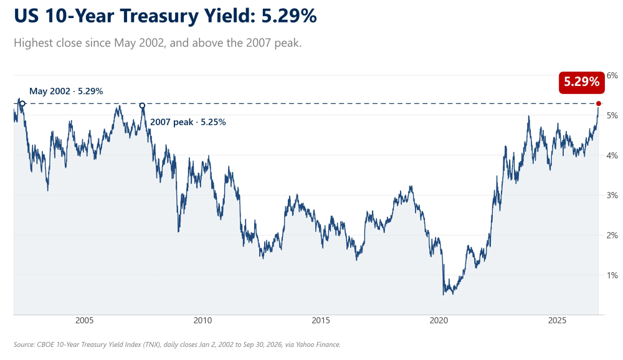
In the 3rd quarter, the 10-year Treasury yield (the typical benchmark for interest rates) rose 0.87% to 5.29%, the largest quarterly increase since 1994. Since the bottom in 2020, the 10-year yield has increased nearly 10x, from 0.5% to 5.3%.
 Why is this so important?
Interest rates are arguably the most important price in the economy. They represent the price of money over time. The cost of borrowing today versus saving and spending tomorrow.
Interest rates matter because they influence nearly every economic and financial decision.
-
Does your business build that factory? It depends on the cost of borrowing relative to the return on that investment.
-
Do you buy that house? It depends on your mortgage rate.
-
Does the homebuilder build more houses? It depends on construction financing costs and whether buyers can afford mortgages.
-
What is a stock worth? It depends on the rate used to discount its future earnings and cash flows.
-
Does the federal government have room to increase spending or cut taxes? It depends partly on how much of its budget goes toward servicing debt (interest costs are currently more than defense spending).
-
Can a state or city afford to build a new highway, school, or hospital? It depends partly on its borrowing costs. In fact, many municipalities are cancelling their latest bond issue due to high interest rates.
Rates influence where capital flows, how assets are valued, and how governments finance themselves. We don’t think it’s hyperbolic to call the interest rate changes of the last several years one of today’s most important stories.
Why are interest rates going up?
Interest rates aren’t just a random number that fluctuates with time. The number itself tells a story. Interest rates reflect the time value of money, expected inflation, the risk of not being repaid (credit risk), and the supply and demand for capital.
Take an illustrative 5% bond. Perhaps 2% is compensation for expected inflation. 1% is the compensation to defer your spending. 1% is due to the issuer’s perceived credit risk. The balance might reflect the supply and demand for funds at the time.
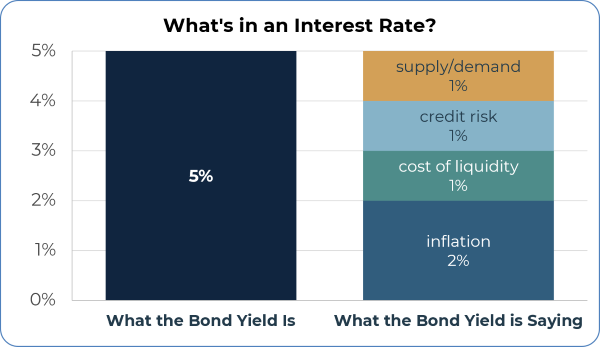
These are illustrative numbers, but teasing apart the components can tell us where the risks lie.
Consider if inflation fears accounted for 4% of that 5% yield, policymakers would have a clear signal to pay attention to. If those fears make financing too expensive to build a home, for example, that’s a real problem. So, diagnosing why a bond yields what it does is as important as simply observing the current level.
Several forces push interest rates higher
Business investment, government borrowing, growth, inflation, and global markets can all push yields higher. These explanations overlap to some degree, and no one knows for sure how they are weighed and how that changes over time. However, there are several factors we believe explain today’s yields.
AI Investment may be crowding out Treasury demand
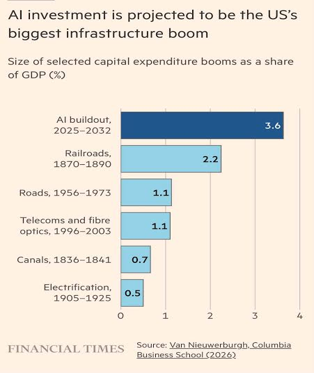
Cumulative global AI infrastructure spending is projected to be between $5-$7 trillion through 2030. According to the Financial Times, AI capital spending will be about 3.6% of GDP, more than the cost of railroads and roads/highways combined. Much of that spending will need to be financed with debt.
 Projected corporate bond issuance is estimated to be around $570 billion by year end. For context, the average from 2020-2024 was about $35 billion. That figure is expected to grow quickly in the coming years.
As more debt is issued, it will compete with other kinds of debt, such as treasuries, for investors. As a result, higher government yields might be necessary just to compete for its share of bond investor demand.
A stronger economy can support higher rates
When the economy is strong, businesses have more reasons to invest, and consumers feel more comfortable spending. Bonds have to compete with those uses of money.
If you see a good opportunity in stocks or your own business, or simply want to spend a little more, you may be less inclined to buy bonds. Higher yields help make them worth your while.
Inflation may be harder to bring down
Inflation is a more concerning possibility. Higher energy prices, for example, can spread into transportation, manufacturing, and household bills. Investors may demand more income to protect their purchasing power.
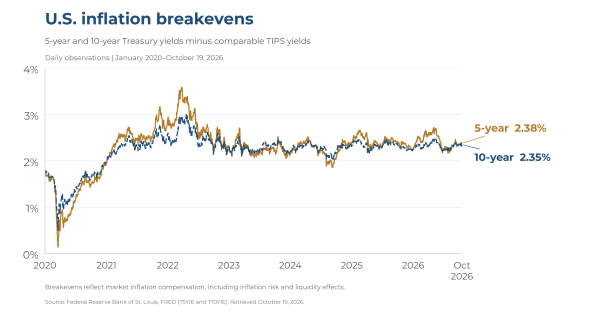
“Inflation breakevens” are a common measure used to gauge how much inflation the bond market expects. They measure the gap between yields on regular Treasuries (nominal) and inflation-protected Treasuries, or TIPS. If a Treasury yields 5% and comparable TIPS yield 3% above inflation, the gap suggests expected inflation of roughly 2%. Despite all the concern about energy prices, these expectations have remained fairly steady, suggesting inflation fears aren’t the main force pushing rates higher.
 Changes in Foreign Demand
Foreign central banks hold U.S. Treasuries as part of their reserves. When they buy less or sell existing holdings, other investors need to fill the gap, often at higher yields. Foreign investors remain major buyers of U.S. Treasuries, but their share of the market has fallen from nearly half in 2014 to roughly one-third in early 2025.
The Federal Reserve may keep rates higher for longer
On September 16, the Fed raised its target rate a quarter point to 3.75%–4.00%, citing solid growth and elevated inflation. The Fed controls the overnight rate (think one-day bonds). The Fed’s outlook for the economy and future rates also shape expectations for longer-term yields.
Government borrowing is adding to the supply of bonds
Meanwhile, the federal government continues to borrow heavily. Attracting buyers for that growing supply of bonds may require higher yields. That’s different from fears of a debt crisis, which we feel are overblown.
What higher rates mean for your portfolio
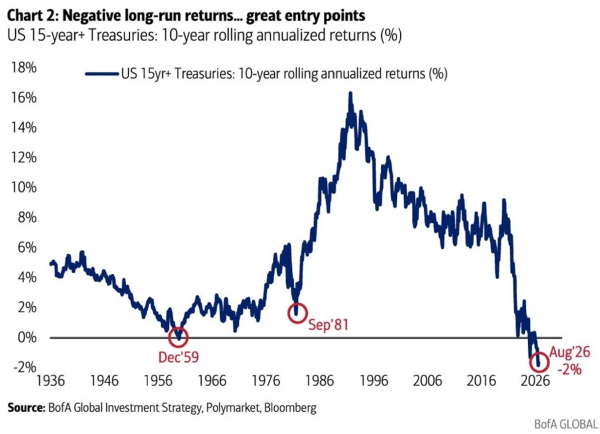
Congratulations! You survived, by some measures, the worst period for U.S. bond performance in history. That may be surprising with net worths generally at all-time highs. Long-term government debt has lost 2% per year over the last decade, its worst 10-year stretch in at least 100 years.
 Fortunately, stocks more than picked up the slack. Over the last five years, the primary bond index (the Bloomberg U.S. Aggregate Bond Index) lost over 1% annually while global stocks have gained over 11%. Most balanced portfolios therefore earned high single-digit returns.
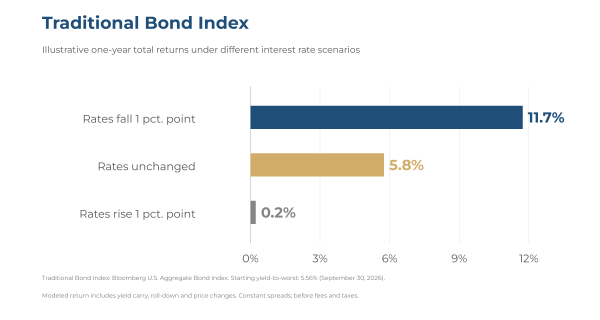
After this “great bond depression,” bonds now yield several times what they did at the start of the decade. As interest rates have gone up, we’ve steadily increased our interest-rate exposure, also known as duration. Duration approximates how much a bond portfolio will rise and fall with a 1% change in interest rates. For example, assume rates are 5% today, and our bond portfolio has a duration of 10 years. If interest rates go down 1% (to 4%), that bond portfolio’s price will appreciate 10% (and vice versa if rates rise).
We can adjust our duration with precision to put the bond portfolio in a strong position and have done so with success in the past. We do so by adding longer-term government bonds, which tend to carry the highest duration.
As the chart below shows, the potential gains if rates fall also compare favorably with the potential losses if rates rise.
 We’re as optimistic about bond returns as we’ve been in decades. Stocks have done much of the heavy lifting, but bonds can now shoulder more of the load. Higher yields provide more income and a cushion against further rate increases, while falling rates could add price gains. That gives us more ways to pursue your goals without relying as heavily on stocks. We’re factoring those opportunities into both your financial plan and how we invest your portfolio.
What is WJ Doing
Aside from increasing the bond portfolio’s duration, the other major change we made last year was reducing our high-yield credit exposure. Credit risk is when you buy bonds from issuers of below investment grade credit quality, such as a “B” grade from one of the major bond rating services. These bonds pay a higher yield, but behave more like stocks in some environments, which reduces overall portfolio diversification. We will repurchase these types of bonds when credit interest rates (typically expressed as “credit spreads”) increase to a level we feel compensates us for the added risk and reduced diversification.
Last there are a couple other adjustments we’ve either made, or will be recommending:
Tax-loss harvesting
Recent declines have left some bond positions worth less than we paid for them. Last week, we sold some of those investments to realize losses that can offset capital gains and reduce your tax bill. We reinvested the proceeds in similar bonds to maintain the portfolio’s overall positioning.
We expect to return to the original position once the wash-sale window has passed. The wash-sale rule generally disallows a tax deduction for a loss if the same or a substantially identical security is purchased within 30 days before or after the sale. Waiting helps preserve the tax benefit of realizing the loss.
The value of those tax savings depends on your circumstances, including the holdings in your taxable account, your tax rate and any gains realized elsewhere.
Municipal bonds
For investors holding substantial cash, municipal bonds deserve a look. Savings accounts, money market funds, and CDs yield about 3.6%–4%, or roughly 2.1%–2.4% after tax at the highest ordinary income rates. Our preferred municipal bond holding, BSNIX, currently yields about 4.93%, tax free, with average credit quality of A. That’s more than twice cash’s after-tax return.
One way to put municipal bond yields in perspective is to calculate their “tax-equivalent yield”, what a taxable bond would need to pay to deliver the same after-tax income. Based on the highest marginal tax-rate, a taxable bond would need to yield about 8.2% to match BSNIX.
To be fair, these are different instruments. Cash investments generally mature within months, BSNIX has a duration of about 5.3 years. But for investors who are comfortable with a little more interest rate sensitivity and credit risk, munis look extremely attractive. We want to reiterate what we said above: now is the time to accept interest rate risk (duration) and lock in the higher long-term yields. That math is simply in your favor.
We’ll reach out to those of you with large cash balances to discuss whether moving a portion into Muni bonds makes sense.
Higher rates don’t tell a single story about inflation, government debt, or the economy. Several forces are at work, and their influence will change over time. We don’t need to predict every turn to recognize that bonds offer more than they did a few years ago: more income, a greater cushion against rising rates, and the potential for gains if rates fall.
That gives us more ways to put your money to work, and less reason to ask stocks to do all the heavy lifting. We’re incorporating those opportunities into your portfolio and financial plan, with your goals, taxes, and comfort with risk in mind. If you’d like to talk through what that means for you, please reach out.
PAST PERFORMANCE IS NOT A GUARANTEE OF CURRENT OR FUTURE RESULTS. Examples of historical information included in this presentation do not, nor are they intended to, constitute a promise of similar future results. Specific client portfolio allocations, risks and returns can and may deviate from these examples depending on accounts and types of investments available through each account. Future market views by WJ Interests, LLC may vary significantly from the historical examples presented herein and no one receiving this summary should assume that WJ Interests, LLC will be able to replicate successful views in the future.